
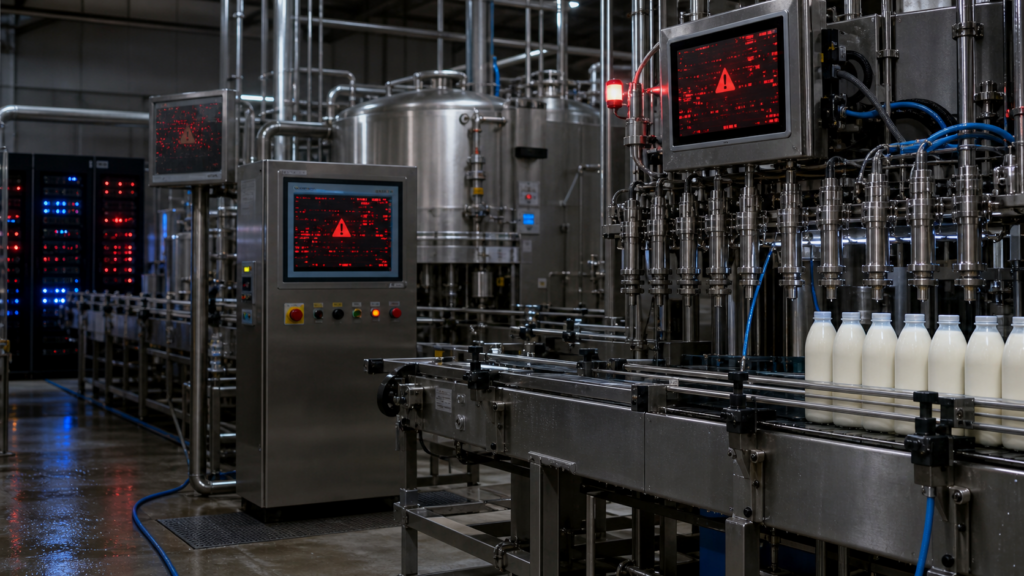

Ransomware used to look like an office problem: locked laptops, frozen email, and a long weekend restoring file servers. Coca-Cola’s disclosure that an attack disrupted Fairlife’s U.S. dairy operations shows how quickly a digital incident can reach the systems that keep physical production moving.
- Coca-Cola said the attack forced Fairlife to suspend production at its U.S. facilities.
- The Anubis ransomware group later claimed responsibility and alleged that it stole about one terabyte of data.
- Manufacturers must recover both business networks and production systems before a plant can safely restart.
A Cyberattack Reaches the Production Line
Coca-Cola disclosed on July 16 that unauthorized access had affected part of Fairlife’s network, including production-related systems. The company suspended U.S. production while it activated incident response and business continuity plans. It also said product quality and safety were not affected, and Canadian production continued normally.
The Anubis ransomware operation later added Fairlife to its data-leak site. The group claimed it had encrypted the company’s Nutanix infrastructure and taken roughly one terabyte of corporate data. Those technical and data-theft claims had not been independently verified, so they should be treated as allegations rather than confirmed findings. Coca-Cola declined to comment on the group’s claims.
Why Manufacturing Changes the Stakes
A factory runs on more than desktops and cloud accounts. Scheduling, ordering, payroll, quality records, industrial controllers, sensors, and filling lines all contribute to the same operation. As business technology and operational technology become more connected, an intrusion that starts on an ordinary network can create uncertainty across the plant floor.
That uncertainty alone can stop production. A manufacturer may need to verify control logic, inspect equipment states, review access logs, confirm batch integrity, and establish that quality systems remain trustworthy. Restoring a server is only one part of recovery when every hour of downtime can affect ingredients, packaging, shipping, and retail supply.
Data Theft Keeps the Pressure On
Modern ransomware crews often combine encryption with data theft. Backups may help a victim restore systems, but they do not erase copied employee records, supplier terms, contracts, or internal communications. The threat of publication gives attackers a second source of leverage even after technical recovery begins.
That is why preparedness must cover more than backups. CISA’s ransomware guidance emphasizes prevention, response planning, and recovery practices. Manufacturers also need tested procedures for deciding when a line should stop, who can authorize a restart, and how production and cybersecurity teams will share evidence during an incident.
Building Resilience Across IT and the Plant Floor
Network separation can limit how far a compromised account or laptop can travel. Organizations should inventory remote-access tools, restrict vendor connections, use multifactor authentication where possible, and monitor pathways between corporate and production environments. Recovery exercises should include operations, safety, quality, legal, communications, and suppliers instead of ending with the IT department.
Endpoint protection still matters, but it works best as part of a layered program. A recent look at a Microsoft Defender zero-day illustrates why automated defenses still need attentive people, timely patching, and practiced response. The Fairlife disruption adds another lesson: organizations that make physical products must plan for a cyber incident as an operational outage, not merely a computer problem.
The full scope of the Fairlife attack will depend on evidence released by the company and investigators. What is already clear is that ransomware can interrupt far more than email. When connected systems support production, resilience has to extend from the office network to the factory floor.