
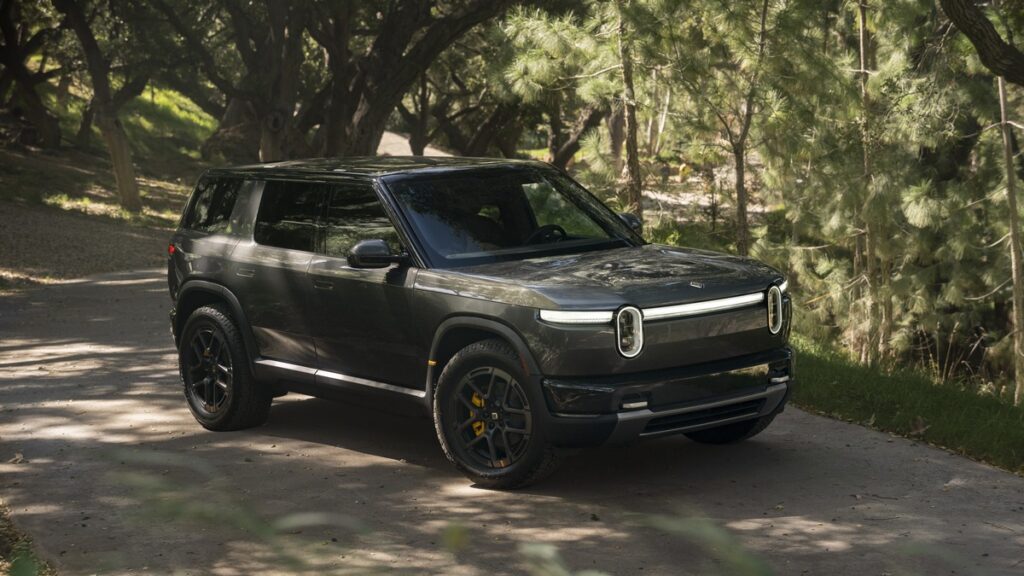

For years the midsize SUV has been the safe, sensible heart of the American driveway. Now a battery-powered newcomer from Illinois wants to shake up that comfortable middle, and its arrival says a lot about where family haulers are heading.
- The Rivian R2 started customer deliveries on June 9, 2026, opening near $60,000 with cheaper trims planned.
- It offers more than 300 miles of range and lands in a segment packed with gas, hybrid, and electric rivals.
- Its timing tests whether buyers still want affordable EVs after a rough stretch for the category.
A Smaller, Cheaper Rivian Arrives
Rivian built its name on pricey adventure machines, the R1T pickup and R1S SUV, both aimed at well-off buyers who wanted a rugged EV with a sense of style. The R2 flips that script. It’s a compact-to-midsize electric SUV roughly the size of a Tesla Model Y, and it’s meant for regular shoppers, not just early adopters with deep pockets.
The first R2s reached customers on June 9, 2026, in a trim starting just under $60,000. Rivian has promised a “standard” version at $48,490 arriving in 2027, plus an even more affordable model starting around $45,000 later that year. Add more than 300 miles of range and the off-road credibility Rivian fans expect, and you can see why the company racked up an estimated 200,000 reservations before a single one hit the road.
The Middle of the Market Just Got Crowded
The midsize SUV space is the most contested corner of the car business, and the R2 is walking straight into it. Volvo brought out its electric EX60 in the same window, another midsize EV with plenty riding on its success. Both companies are betting families are ready to plug in for their everyday hauler.
What makes this fight interesting is that the R2 isn’t only competing with other EVs. Shoppers cross-shopping a family SUV still weigh gas and hybrid options too. Someone who walks into a GMC Acadia dealer looking at a three-row gas SUV represents exactly the mainstream buyer Rivian now hopes to win over. That’s a tall order. The Acadia and its peers have decades of trust, dealer networks, and predictable resale value behind them. The R2 has to prove an electric SUV can match that everyday practicality while offering something the gas crowd can’t.
Timing Is the Hard Part
Rivian picked a rough moment to go mainstream. The EV market cooled sharply over the past couple of years. More than a dozen automakers pulled back on electric plans. Ford scrapped the F-150 Lightning, Honda killed its Zero series, Volkswagen idled the ID.4 and ID.Buzz, and Nissan dropped the Ariya. The industry booked over $70 billion in EV-related write-downs in a single year. The federal $7,500 tax credit that once helped move these cars is gone, and tariffs made cheap imports nearly impossible to bring in.
Rivian felt the chill directly. The company sold 42,247 vehicles in 2025, an 18 percent drop from the year before, and it has yet to post an annual profit. Even Tesla saw sales slide two years running, though its Model Y still moved over 1 million units in 2025. That figure proves the appetite for a well-built electric SUV is real. The question is whether Rivian can grab a meaningful slice of it with a car most people can actually afford.
Why This Launch Matters for Everyone
The R2 is a stress test for the whole midsize category. If a genuinely likable, reasonably priced electric SUV can find buyers in this climate, legacy brands will feel pressure to speed up their own affordable EV plans. If it stumbles, expect more automakers to lean harder on hybrids as the safe bridge to an electric future.
Charging will be part of that verdict too. A 300-mile estimate sounds reassuring on a spec sheet, but families judge an EV by winter range, highway efficiency, charging speed, and whether a dependable charger fits into the routine at home. Public fast-charging access keeps improving, yet the easiest ownership experience still belongs to drivers who can plug in overnight. Rivian has to make that transition feel ordinary, not experimental, while keeping software updates, service appointments, and road-trip planning painless. Those practical details rarely dominate a reveal event, but they often decide whether a promising electric SUV earns a second purchase recommendation. Strong battery management and software updates will matter just as much as the hardware.
For anyone shopping the family SUV aisle over the next couple of years, that competition is good news. More choices, sharper pricing, and better technology tend to follow when a scrappy newcomer forces the establishment to respond. The R2 won’t settle the midsize battle on its own, but it’s a strong signal that the fight for the middle of the market is heating up fast. Keep an eye on how buyers respond, because their verdict will shape what shows up in showrooms next.