
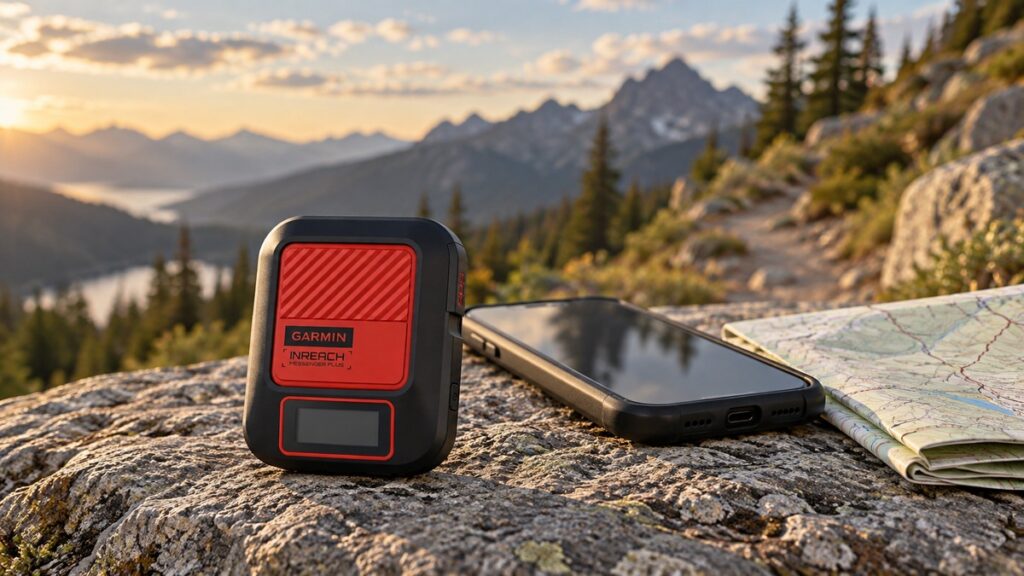

When cell towers disappear and the trail keeps climbing, a satellite communicator becomes your lifeline. Garmin’s inReach Messenger Plus pushes that idea forward with longer texts, voice notes, and photo sharing, all backed by battery life measured in hundreds of hours.
- Sends texts up to 1,600 characters, far past the old 160-character cap on many Garmin devices
- Adds photo sharing and 30-second voice notes over the Iridium satellite network
- Advertises up to 600 hours of battery life in 10-minute tracking mode
What Sets the Messenger Plus Apart
Garmin built the inReach Messenger as a stripped-down cousin of the inReach Mini, keeping the parts that matter most in the backcountry: two-way messaging and an SOS button. The Messenger Plus sits at the top of that line. It weighs about 4 ounces and uses the Iridium satellite network for coverage that reaches well beyond the last bar of cell signal.
The headline change is message length. Older Garmin units capped texts at 160 characters and chopped anything longer into pieces that sometimes arrived out of order. The Messenger Plus lifts that ceiling to 1,600 characters, so a full weather note or check-in goes out in one clean message. Send to another non-Plus Garmin device, though, and long texts still break apart on the receiving end. There’s a nice touch for two-way chats too. When someone reacts with a Tapback like a heart or a thumbs-up, that reaction doesn’t count against your message totals.
Voice, Photos, and the Smartphone Catch
Beyond plain text, the device records short voice notes and sends photos, both over satellite when it’s paired with a phone. That opens up richer updates to family, and it could matter in a rescue situation where a photo of your surroundings helps searchers pin down where you are. Voice notes top out at 30 seconds, which passes quicker than you’d expect, so it pays to say only what counts.
Here’s the tradeoff: photo and voice messaging use the Garmin Messenger app on a compatible phone. The separate Garmin Explore app supports trip planning and navigation features. Losing phone power limits those richer functions, but it does not remove every way to communicate. The Messenger Plus can send messages, location updates, and an SOS directly from the device. Activate the required satellite subscription before relying on satellite communication, and practice the on-device controls before leaving cell coverage.
Battery Numbers Worth Knowing
Battery life is where this thing really earns its keep. Garmin lists up to 600 hours with a text or location sent every 10 minutes in low-power messaging mode and about 120 hours when a text or location goes out every two minutes. A single charge supports up to 250 media messages, and the review lists up to a year of stored charge when the unit is powered off. Those figures assume a clear view of the sky. Duck under heavy tree cover or steep terrain and the device works harder to find a satellite, which drains the battery faster.
The Trek’s reviewer used the device for weather checks, family messages, and tracking on the Slovenian Mountain Trail without recharging it. That is a useful field report, but it does not establish that every trip will meet the advertised maximum. Message frequency, settings, and satellite visibility still matter.
Who Should Put One in Their Pack
This communicator makes the most sense for backpackers and long-distance hikers who use their phone for maps and want detailed off-grid messaging. If you’re mapping out a remote trip where you’ll be far from a signal, whether you’re hiking in or rolling toward a trailhead on something like a Polaris XPEDITION UTV, the planning question is similar: how will you check in or request help beyond cell coverage, and what equipment, power, and service activation does that require?
The phone adds much of the flexibility, while the communicator retains important standalone functions. Before a trip, confirm your subscription, learn both interfaces, and plan for phone power as well as the communicator’s battery. Photos and longer messages can make an update more useful, but no advertised battery rating replaces preparation or guarantees a rescue outcome.