
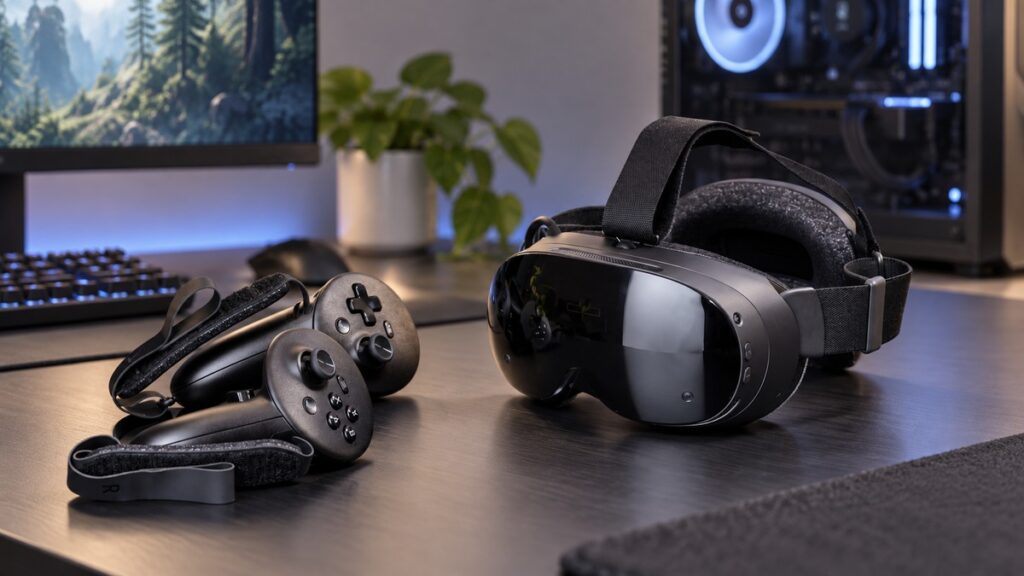

Valve is back in the headset business with the Steam Frame, a wearable PC that plays your Steam library, streams from your desktop, and dabbles in VR along the way. It costs plenty, and it still behaves like a beta.
- The Steam Frame starts at $1,059 for 256GB and $1,299 for 1TB, running Linux on a Qualcomm Snapdragon 8 Gen 3 chip.
- It streams PC games, emulates Windows titles, plays Meta Quest VR games, and runs native Linux apps, all from one lightweight headset.
- Early software brings crashes, short one-to-two-hour battery life, and limited standalone performance, but Valve plans steady updates.
A wearable computer first, a VR headset second
The Steam Frame runs on an Arm-based Qualcomm Snapdragon 8 Gen 3 chip and a version of Linux built for that hardware. It weighs just over a pound, roughly 469 grams with the optional top head strap fitted. Two storage tiers are on offer: $1,059 for 256GB and $1,299 for 1TB. That lands at about two to three times the price of similar-looking headsets from Meta.
Comfort sits near the center of the pitch. Early hands-on coverage praised the headset’s comfort. Its curved rear section houses a small battery. A $59 accessory kit adds hand straps and the top head strap for people who want a more secure fit.
So many ways to play
Games can run in several different ways here. The Frame can stream flat or VR titles from a Steam-equipped desktop or laptop over Wi-Fi or an included 6GHz wireless dongle. Less demanding Windows games run through emulation on the headset’s own chip. Because Valve built in support for Meta’s Android-based VR software, the Frame can also play many titles designed for the Meta Quest. And a growing catalog runs natively on its Linux-on-Arm setup, including a standalone version of 2020’s Half-Life: Alyx.
The display does real work too. Each LCD panel offers 2160 x 2160 per eye. By default Valve locks flat games to 1280 x 720, but older or lighter titles can be pushed far higher. Eye-tracking supports foveated rendering, which keeps the image sharp where you’re looking and eases off elsewhere to save power.
Beyond games, the Frame doubles as a media machine. There are no dedicated Netflix or YouTube apps, but DRM-protected video plays fine in the built-in Chromium browser, and VLC handles local files. You can stream a PS5 to the headset using the Asobi app, and 3D Blu-ray rips play through apps like Skybox in a virtual theater. The controllers pack every button, stick, and trigger of an Xbox gamepad alongside their VR controls.
The rough edges of early access
Early hands-on coverage describes crashes, vanishing audio and controls, and full power losses. Standalone performance trails the aging Steam Deck for flat games, with more demanding titles better suited to PC streaming. Battery life is short, with heavy games draining the 21.6-watt-hour cell in under an hour and battery-saving or streaming modes stretching to about two. A rear USB-C port makes it easy to route a cable down to a battery in your pocket.
Streaming carries its own quirks. Valve’s “multi-link” tech, which balances home Wi-Fi and the 6GHz dongle, currently kicks in only when you stream your whole PC rather than a single window. Passthrough vision is monochrome out of the box. Compatibility is a work in progress as well, with “Verified” and “Unsupported” badges and a “Great on Frame” store page, though around 130 titles carried the Verified label during the early review period.
Modular by design and built to grow
Valve’s plan leans on updates and add-ons. The compute core detaches, so future straps, speakers, and batteries can swap in. A partner called Arcturus already sells a $150 camera that presses into the nose bridge and turns the monochrome passthrough into 5K color with HDR. Valve has its own “Enthusiast Kit” coming with a new strap, a second stackable battery, floating speakers based on the Index Ear Speakers, and extra eye spacers, though pricing and timing haven’t been shared. Hand-tracking is said to be working under the hood and could arrive later.
Who the Steam Frame is really for
The Steam Frame asks a lot: a four-figure price and patience for software that’s still finding its footing. Anyone who just wants polished VR can find cheaper, more finished options today. But for tinkerers who enjoy watching a company build something in public, it offers a rare thing, a wireless headset aimed at open PC gaming instead of a walled garden. Valve plans further updates, but buyers still have to weigh the software available now.