
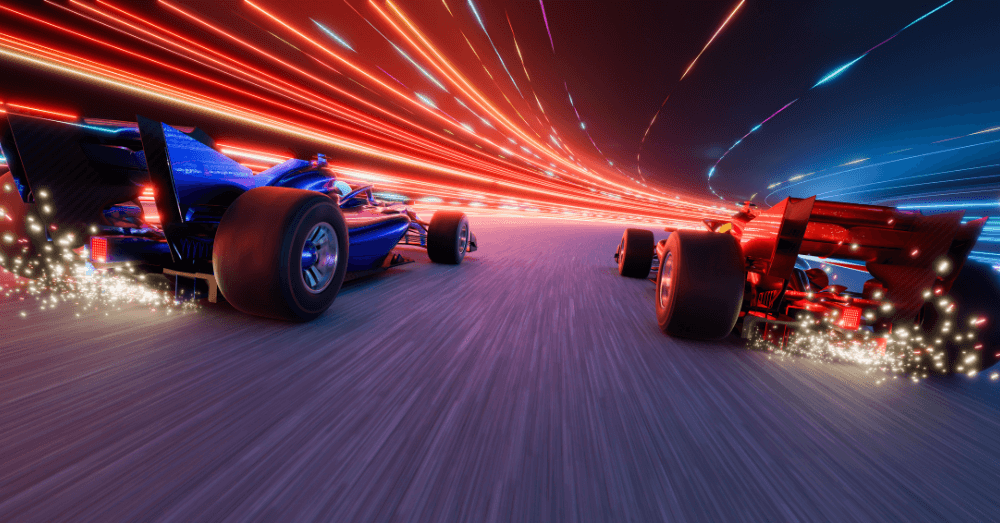

Race tracks have become the perfect proving ground for self-driving technology. What happens when you push autonomous vehicles to their absolute limits at speeds most of us will never experience? The answer tells us a lot about the future of the cars we’ll drive on regular highways.
- Autonomous racecars hitting 180+ MPH at competitions like the Indy Autonomous Challenge are testing perception systems under extreme conditions that reveal weaknesses before they become problems in consumer vehicles.
- Sensor fusion technology that keeps these vehicles from crashing at racing speeds is now filtering into the advanced driver assistance systems showing up in new cars.
- University teams from around the world are programming AI drivers that can handle split-second decisions at triple-digit speeds, and those algorithms eventually make their way into the cars parked in your driveway.
Racing as a Stress Test for Self-Driving Software
Picture this: four fully autonomous racecars tearing around a track at over 160 MPH, making passes, calculating trajectories, and avoiding collisions. No human drivers. No remote control. Just AI making decisions faster than any person could react. This actually happened at CES 2025 in Las Vegas, marking the first time multiple autonomous vehicles completed a full race with several overtakes and zero accidents.
When an autonomous racecar at the Indianapolis Motor Speedway in Speedway, Indiana clocks 184 MPH, every sensor has to work perfectly. Every algorithm needs to process information in milliseconds. Glitches that might go unnoticed at 35 MPH in city traffic become catastrophic failures at racing speeds.
Racing pushes autonomous systems into situations where failures show up immediately and dramatically. If your perception stack can’t track another vehicle while both of you are doing 180 MPH, you’ll know within seconds. Compare that to highway driving where issues might take thousands of miles to surface.
From Track to Street: How Racing Tech Becomes Consumer Safety
IAC AV-24 racecars use sensor arrays that combine cameras, LiDAR, and radar. You’d find similar setups in a new Tesla or Mercedes. Racing environments demand these systems work flawlessly under conditions that would make most engineers nervous.
High-speed racing creates what researchers call “edge cases”—those rare situations that autonomous systems need to handle but don’t encounter often enough during normal testing. When two autonomous racecars approach each other at a closing speed of 300+ MPH, sensor fusion algorithms better be perfect. Once that technology proves itself on the track, engineers refine it and scale it down for everyday use.
Take the passing maneuvers these university teams have perfected. Winners at the 2024 Indy Autonomous Challenge completed overtakes at 180 MPH. AI had to predict where the other car would be, calculate an optimal path, and execute the pass without human input. Those same prediction and path-planning algorithms are now being adapted for highway lane changes at normal speeds.
Perception Problems Get Solved at Speed
Consumer self-driving systems struggle with what engineers call “perception gaps”—moments when sensors miss something or misclassify an object. In 2018, an Uber autonomous test vehicle in Arizona killed a pedestrian partly because its perception system couldn’t decide if the person was an unknown object, a vehicle, or a bicycle.
Racing doesn’t allow that kind of uncertainty. When you’re traveling at speeds where a single second equals 270 feet of distance, your perception stack needs to be right the first time. Multi-sensor fusion approaches that teams use to track competitors at these speeds are teaching us better ways to combine camera and LiDAR data.
Here’s how these racing competitions have evolved: IAC started in 2021 with single-car time trials. By January 2025, they’d achieved multi-car races with overtakes. That progression mirrors how consumer autonomous technology is developing—starting with basic highway assistance and moving toward more complex scenarios.
Why Your Next Car Benefits from Racing Research
Most drivers won’t buy a fully autonomous vehicle anytime soon. Current surveys show only 13% of Americans would trust riding in one. But technology being tested on race tracks is already showing up as advanced driver assistance features in new vehicles.
Sensor calibration methods that keep racecars stable at 190 MPH are being adapted for collision avoidance systems that work at normal speeds. Machine learning models that help AI drivers predict competitor behavior are informing how consumer systems anticipate other drivers’ movements in traffic.
Racing provides an accelerated development environment. Problems that might take millions of miles to discover in regular testing show up in a few laps at racing speeds. Algorithms get refined, sensor fusion techniques get better, and eventually that knowledge trickles down to the adaptive cruise control and lane-keeping systems available at your local dealership.
Autonomous racecars lapping tracks today are testing grounds for the safety systems that will keep regular drivers safer tomorrow. Every sensor that works at 180 MPH will work even better at 65. Every algorithm that handles split-second decisions in competition becomes more reliable in everyday traffic. Proving the technology works when it matters most is what drives this whole effort forward.